UW-Madison’s funding covered the first 20 solar arrays, with the first 17 installed in April 2024 and the remaining 10 being slated for installation in April 2025.
Photo: Ian Aley
5 min to read
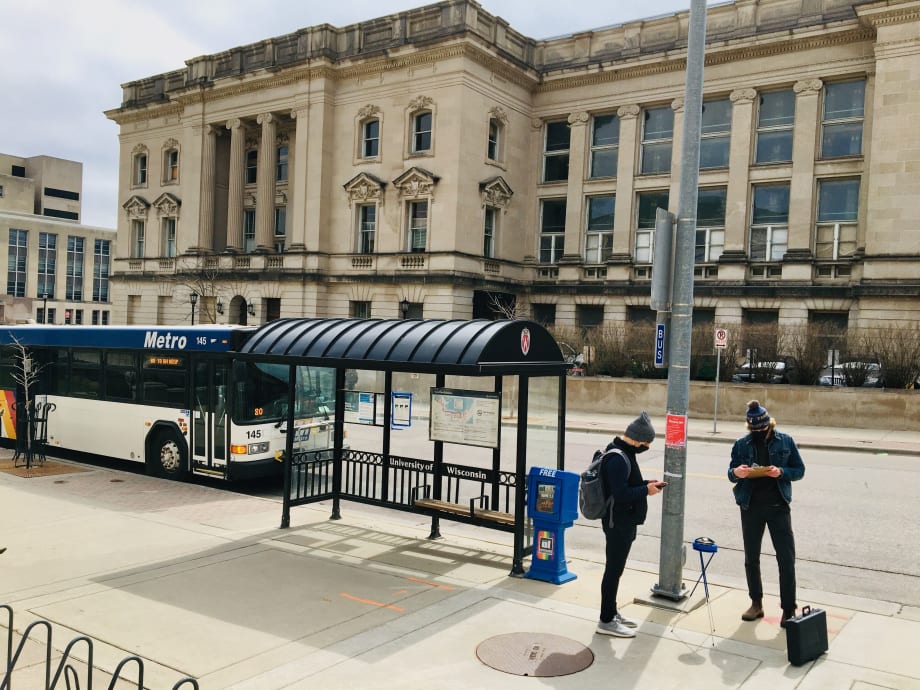
The University of Wisconsin–Madison’s (UW) Transportation Services department was looking for a way to add amenities that would encourage people to take transit, while simultaneously discouraging them from driving.
While it was already tracking vital transit data, including automatic vehicle location, Transportation Services officials were looking to install screens with real-time arrival information at its bus shelters located throughout campus.
Ad Loading...
The problem with installing the displays, though, was the power necessary to install the signage — electrical wires would need to be extended from a nearby building, which would be difficult, expensive, and require many approvals, according to UW officials.
In an attempt to solve the issue, Transportation Services teamed up with two student organizations: Helios, which focuses on solar-powered sustainability, and Enactus, a national organization that seeks to use entrepreneurship to benefit social causes.
Student-Led Research
The organizations filed a joint submission to the Office of Sustainability’s Green Fund, which connected them with experts on campus and awarded the team a $1,400 grant to purchase equipment to study the feasibility of the project.
The demonstration then proved successful and the team was awarded $100,000 in funding allocated for sustainability projects by the UW-Madison Physical Plant’s Green Fund.
“While the funding partnership was important, the UW students’ research and reporting during the project’s feasibility study was crucial,” explains Dar Ward, commuter solutions manager, Transportation Services, at UW-Madison. “Partnerships are key to any successful public project.”
Ad Loading...
As a next step, UW-Madison students conducted extensive field data collection and solar modeling to determine the feasibility of adding curved solar panels to each bus shelter around campus.
The students involved in the study were majoring in mechanical engineering, material science, chemistry, finance, information systems, and economics.
The study concluded that 51 of 66 shelters could power a display and lights with an average of about two curved panels, with several only requiring not more than one panel to generate sufficient energy.
Meanwhile, about a quarter of the stops needed three panels on the shelters because they were located in areas shaded by tall buildings and trees.
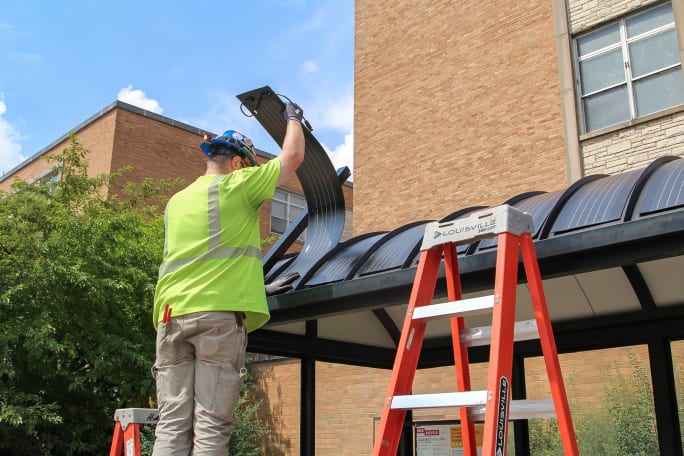
UW-Madison’s Transportation Services contracted with Urban Solar to add curved solar panels on barrel roofs on campus bus shelters.
Photo: Lauren Graves
Expanding the Partnership to Continue Success
UW-Madison’s Transportation Services then contracted with Urban Solar — a North American market leader in off-grid lighting and amenities for bus stops — to add curved solar panels on barrel roofs on campus bus shelters.
Ad Loading...
The unique integration into the existing roofline allowed for an aesthetically pleasing and sustainable approach to improve rider experience.
“The university researched various approaches and determined a project manager was required to integrate all aspects: solar panels, real-time transit information, and lighting,” explains Ward. “We also needed a company willing to collaborate with us on the innovative flexible solar panel concept, rather than simply recommending flat panels. Urban Solar met these needs and submitted a competitive bid.”
Urban Solar, with its ability to leverage supplier partnerships, was able to help bring UW-Madison’s customized project to life.
“UW-Madison felt the standard solar transit products on the market were not sufficient for the sustainable, reliable, and aesthetic design they envisioned,” says Brianna Kerwin, customer success and project manager, at Urban Solar. “As a result, the university submitted a bid with clear direction to incorporate flexible panels, solar lighting, and digital displays into their existing UW shelters. Urban Solar was up to the challenge; by leveraging our in-house engineering team and strong supplier partnerships, we designed and built a customized solar product for the UW campus.”
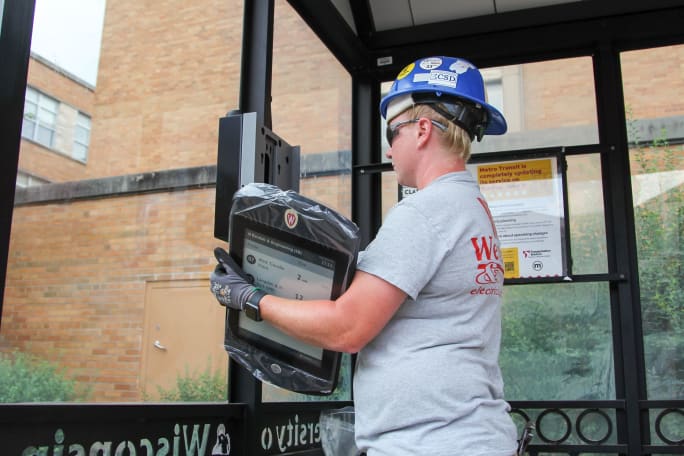
As part of its work, Urban Solar worked with several partners for this project, which supplied key components such as the e-paper displays, custom flexible solar panels, remote monitoring controllers, LED luminaires, and the installation service itself.
Ad Loading...
“The most important aspect of this project’s achievement was the continuous collaboration between Urban Solar’s design team, UW’s student research, the University's Office of Sustainability, and UW transportation services,” says Kerwin.
Urban Solar, with its ability to leverage supplier partnerships, was able to help bring UW-Madison’s customized project to life.
Photo: Lauren Graves
Crossing the Finish Line
UW-Madison’s funding covered the first 20 solar arrays, with the first 17 installed in April 2024 and the remaining 10 being slated for installation in April 2025.
The solar panels installed at the bus stops provide power for screens displaying real-time bus arrival information and lights that make the shelters safer at night, making riding the bus all the more accessible for students, faculty, staff, and visitors — the original end goal for UW-Madison.
By completing its project through the use of renewable energy, the university is able to reduce its environmental footprint of the project, while also saving dollars by not having to run electrical lines to bus shelters, which would have proven to be cost prohibitive.
“This recognition is a testament to the teamwork that made this project a success,” says Ward. “We’re excited about the positive impact the solar-powered bus stops will have on our campus and hope this project inspires others to pursue innovative sustainability solutions. This project also demonstrates the kind of collaborative, campus-based effort that supports the university’s operational sustainability goals, leverages our staff’s expertise, and offers hands-on learning opportunities for students.”
“We strive to support customers who are early adopters of new technology and are passionate about finding highly innovative and sustainable solutions to meet the needs of their transit ridership,” adds Kerwin. “The combined effort of student research, UW staff initiative, and Urban Solar’s expertise in off-grid solar design was key to this project's success. We look forward to seeing the ongoing impact that solar-powered security lighting and real-time information displays will have on the university community in Madison.”
As chair of APTA’s Business Members Board of Governors, Ray Melleady explains how more than 850 business members are partnering with transit agencies to advance funding, innovation, and industry-wide collaboration.
In this edition, METRO also covers recent appointments and announcements at the DART, STV, and more, showcasing the individuals helping to shape the future of transportation.
METRO's Innovative Solutions Award winner replaces complex service-area descriptions with an accessible, interactive map that puts paratransit information directly in customers’ hands.
Through its NAVI program, JTA is showing how autonomous vehicles, intelligent infrastructure, and coordinated operations can work together to deliver everyday public transportation.
From manufacturers and suppliers to transit agencies and motorcoach operators, these updates offer a snapshot of the projects, partnerships and business moves driving the industry forward.
The award-winning partnership combines AI-powered detection with human oversight to improve bus reliability, accessibility, and enforcement efficiency.
The award-winning Workforce Transit Modernization project replaced paper bidding with a transparent digital platform, cutting administrative effort while improving access for operators.